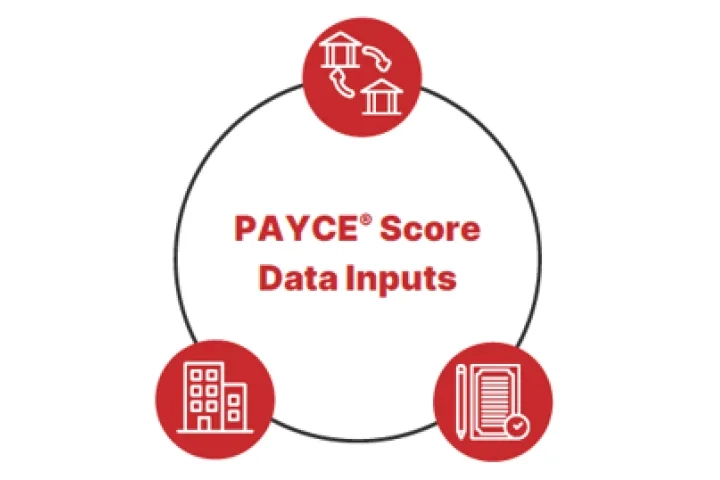
From January through December 2025, the PAYCE® Score predicted bankruptcies across North America, including many mega-bankruptcies with liabilities of $1 billion or more. These companies were flagged as “high risk” at least three months in advance. Importantly, nearly 50% of the largest company bankruptcies showed prompt or near-prompt trade payment behavior shortly before filing (the cloaking effect). Because of this, traditional trade-only models did not flag them. We expect private-company bankruptcies to remain elevated through 2026.

Resources
Stay Ahead With In-Depth Analytics on Public And Private Companies
Specialty retailer, The Container Store Group, Inc., filed for bankruptcy on December 22, 2024. The FRISK® Score had signaled the company’s financial distress for 12 consecutive months, providing early warning to subscribers. Yet the company’s Days Beyond Terms Index, a measure of historical trade payment performance, persistently indicated prompt payment behavior. The divergence between these indicators is known as the “Cloaking Effect”.
CreditRiskMonitor.com, Inc. reported operating revenues of $5.1 million, an increase of approximately $85 thousand or 2%, for the third quarter of fiscal 2025 compared to the same period of fiscal 2024.
When WW International (Weight Watchers) filed for bankruptcy, credit professionals relying solely on financial-based models like the Z''-Score did not detect the company’s financial distress. CreditRiskMonitor’s 96%-accurate FRISK® Score – a real-time, hybrid model – flagged WW International’s financial distress well in advance, offering a crucial early warning. This case underscores the power of combining financial data, stock market performance, aggregate insider sentiment, and agency ratings for precise bankruptcy predictions.
What are the root causes of the failure of risk models to provide adequate warning? After nearly 25 years of company operation and observation, CreditRiskMonitor® has identified four common problems among competing risk models.